When Machines Start to Purchase: How Agentic Commerce Redefines Competitive Advantage
When Machines Start to Purchase: How Agentic Commerce Redefines Competitive Advantage
Mehmet Ali Koseoglu & Rassule Hadidi
Metro State University
What happens when your next customer isn’t a person—but an agent?
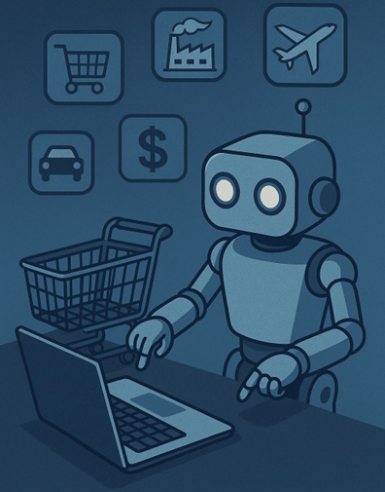
Imagine this: an intelligent software agent representing a household opens ChatGPT, compares grocery prices across multiple platforms, negotiates discounts in real time, and automatically places the order—all without human involvement. At the same time, another agent representing a supplier adjusts inventory levels, anticipates demand spikes, and recalibrates pricing to match the demand. No meetings, no calls, no human clicks, just autonomous negotiation, optimization, and execution.
According to McKinsey & Company (Schumacher, Roberts, & Giebel, 2025), agentic commerce is “moving from pilot to mainstream,” with hundreds of millions of AI-driven consumer agents expected to transact globally within a few years, representing one of the fastest shifts in digital commerce behavior in history. This isn’t a distant vision of the future. It’s the new reality emerging through agentic commerce, a revolutionary model in which autonomous AI agents transact, negotiate, and collaborate on behalf of humans, businesses, and even other machines. These intelligent entities aren’t merely assistants; they are actors in the marketplace, capable of perceiving goals, learning from experience, and dynamically making decisions. Agentic commerce marks a profound shift in how markets function. For centuries, commerce has revolved around human intention, our preferences, constraints, and decisions. The Industrial Revolution mechanized production. The digital revolution virtualized it. Now, the agentic revolution is automating cognition itself. Economic exchange is moving from human-to-human to machine-to-machine, and soon to ecosystem-to-ecosystem.
In this new economy, the traditional boundaries between buyer and seller blur. Agents act as autonomous negotiators that analyze millions of data points, pricing, logistics, sustainability, and consumer sentiment, and decide what, when, and how to buy or sell. For businesses, this means that competition will no longer hinge solely on human insight or brand power, but on how intelligently their digital agents can act in complex, fast-moving ecosystems.
The implications are staggering. Decision cycles that once took days now unfold in milliseconds. Market responses that depended on managerial experience are now driven by adaptive algorithms. Strategies once formulated in boardrooms are increasingly encoded into learning systems that continuously evolve.
As Walmart, Shopify, and OpenAI begin to operationalize this model through the Agentic Commerce Protocol, a framework allowing AI agents to buy, sell, and communicate securely across digital platforms (Weinstein & Kaliski, 2025), the transformation is no longer theoretical. Walmart’s integration of ChatGPT Instant Checkout already allows shoppers to purchase items directly through conversational AI (Grantham-Philips, 2025; Schwartz, 2025). Shopify and Etsy are also connecting millions of merchants into similar agentic networks, demonstrating that autonomous trade has entered the mainstream (Reuters, 2025a). Similarly, Uber has proposed an AI tech stack that is “autonomous, coordinated, goal-driven, and evaluated” (Uber Technologies Inc., 2025). In short, the rules of competition are being rewritten at machine speed. The advantage now belongs to those who can design, deploy, and trust intelligent agents to act strategically, creating a new form of market power built not on labor or capital, but on learning, adaptability, and systemic intelligence.
From Automation to Autonomy: Defining the Agentic Shift
To understand this transformation, we need to move beyond the vocabulary of automation.
Automation performs; agency decides.
Agentic commerce represents the next evolutionary stage of digital trade, where systems don’t just follow instructions but interpret objectives, negotiate trade-offs, and pursue outcomes. This next section explores what agentic commerce truly means—its architecture, mechanics, and why it’s redefining how firms create and sustain competitive advantage.
What Is Agentic Commerce?
There are already various definitions for agentic commerce. Warmoth (2025) describes Agentic Commerce as an autonomous agent that acts on behalf of users to search, compare, decide, and purchase. Norris (2025) states that in agentic commerce, the agents’ role changes from being reactive to proactive. Schumacher, Roberts, & Giebel (2025) state that some researchers predict that by 2028, about 15% of day-to-day decisions may be made by agentic AI. Agentic commerce represents the next great inflection point in digital transformation, a convergence of artificial intelligence, autonomous systems, and decentralized market logic. In its simplest form, it describes commerce conducted by autonomous agents, intelligent algorithms that can independently sense needs, evaluate alternatives, negotiate, and execute transactions (Warmoth, 2025).
Unlike traditional e-commerce systems that merely automate tasks, agentic commerce introduces machine agency, the capacity of AI systems to make context-aware decisions on behalf of humans or organizations. These agents are not passive executors of preprogrammed rules; they are adaptive entities capable of learning, reasoning, and pursuing goals dynamically.
At its core, agentic commerce fuses three technological streams:
- Conversational AI – enabling natural, human-like interactions between users and systems (as seen in ChatGPT-based shopping assistants).
- Autonomous Decision Engines – using reinforcement learning and predictive analytics to determine optimal actions in real time.
- Interoperable Ecosystems – built on standardized protocols and APIs that allow agents from different firms to transact, negotiate, and share data securely.
Together, these capabilities form the architecture of what Weinstein & Kaliski (2025) have described as the Agentic Commerce Protocol, a shared framework that ensures trust, security, and verifiability in machine-to-machine transactions.
Recent breakthroughs show that this concept is already moving from lab to market.
In October 2025, Walmart and OpenAI announced a partnership enabling consumers to shop directly within ChatGPT using Instant Checkout (Grantham-Philips, 2025; Schwartz, 2025). The AI doesn’t just search for items; it understands shopping intent, curates options, and finalizes the transaction, essentially acting as a personalized buyer-agent.
Simultaneously, OpenAI extended the same capability to Etsy and Shopify, connecting millions of small merchants to this ecosystem (Reuters, 2025a). This collaboration ushers in the age of autonomous shopping, where consumers delegate decisions to intelligent agents trained on their preferences and constraints (Schumacher, Roberts, & Giebel, 2025).
These developments blur the line between consumer and enterprise AI. When an AI agent can represent an individual, a household, or even a corporation, it fundamentally alters how demand and supply interact. In Salesforce (2025), agentic commerce allows businesses to move from reactive selling to proactive serving, an environment where transactions are not initiated by human requests but by predictive algorithms anticipating them.
This shift also transforms the concept of the marketplace itself. Traditional platforms like Amazon or eBay organize human buyers and sellers. Agentic commerce organizes intelligent entities, each capable of evaluating millions of micro-variables at once. Transactions thus evolve from one-time exchanges into continuous optimization loops, where agents learn, adapt, and collaborate across networks.
The result is a new kind of economic intelligence—fluid, predictive, and deeply interconnected. In such an environment, advantage no longer depends merely on access to data, but on how effectively agents interpret and act on that data in milliseconds. Competitive advantage becomes less about who owns the platform and more about whose algorithms learn fastest, negotiate smartest, and operate most ethically.
In essence, agentic commerce is not an extension of e-commerce; it’s an evolution beyond commerce itself. It transforms the act of exchange into a living system of adaptive intelligence, where every interaction contributes to collective market learning. Hence, agentic systems will not just perform transactions; they will continuously redefine what value means (Paterson, 2025)
This emerging reality sets the stage for a radical rethinking of strategic theory. If traditional competitive advantage was built on cost, differentiation, and control, agentic commerce replaces these with speed, adaptability, and algorithmic trust, a new strategic logic suited to a world where machines, not managers, increasingly shape the flow of value.
The Strategic Disruption Ahead
Agentic commerce is not merely an upgrade to digital retail; it is a strategic disruption of market logic itself. For over half a century, competitive advantage has been grounded in Michael Porter’s (1980) enduring framework: five forces, rivalry, buyer power, supplier power, threat of new entrants, and threat of substitutes, defining the structure of competition.
Yet, in agentic markets, these forces mutate. Buyers and sellers are no longer solely human actors; they are intelligent systems that can anticipate moves, negotiate prices, and make instantaneous adjustments. Barriers to entry collapse when a small firm can deploy hundreds of autonomous agents capable of executing a strategy with near-zero marginal cost. Supplier power shifts toward those who control data access and algorithmic training pipelines rather than raw materials or labor.
Most strikingly, rivalry among existing firms becomes continuous and self-optimizing. Agents don’t rest, pause, or wait for quarterly reviews; they learn 24/7. In such an environment, strategy becomes a living process rather than a static plan.
This shift challenges the very foundation of traditional strategy design. The once-linear model of “analyze, choose, implement” gives way to an adaptive feedback model of “sense, learn, evolve.” Competitive advantage is no longer defined by where a firm competes or what resources it owns, but by how fast its systems can perceive, decide, and improve.
As Paterson (2025) observes, agentic ecosystems create an always-on marketplace of cognitive competition, where value flows toward entities with the highest learning velocity. McKinsey’s analysis warns that agentic commerce will compress margins industry-wide as AI agents erode traditional brand advantages and favor sellers with optimal price–value–trust combinations (Schumacher et al., 2025). Hence, the organization’s new strategic assets are algorithmic agility, data integrity, and ecosystem interoperability.
The corporate examples are multiplying quickly.
- Walmart’s collaboration with OpenAI demonstrates how retailers are using conversational AI to compress the customer journey and personalize offers instantaneously (Grantham-Philips, 2025).
- Salesforce’s Agentforce platform, developed in partnership with OpenAI and Anthropic, equips firms with autonomous agents that can interact across customer, logistics, and marketing systems, illustrating the horizontal diffusion of agentic capabilities (Reuters, 2025b; Salesforce, 2025).
- And through Shopify’s integration with ChatGPT Instant Checkout, even small merchants gain algorithmic reach that once belonged only to tech giants (Reuters, 2025a).
As Vu, Burns, and Cheris (2025) emphasize in Harvard Business Review, the emergence of “AI shoppers” requires retailers to redesign the customer journey for machine actors rather than just humans. They argue that retailers must develop product data structures, APIs, and decision-friendly metadata that allow autonomous agents to interpret, compare, and transact efficiently. This aligns closely with the notion of agent readiness presented here—firms like Walmart and Shopify are already treating machine-readable design as the new competitive differentiator. In other words, as HBR notes, retailers who optimize for agent-to-agent communication will become the preferred trading partners in tomorrow’s digital ecosystems.
These developments collectively redefine strategic positioning. When every firm can access intelligent tools, the advantage migrates from ownership to orchestration. Leaders will distinguish themselves not by the sophistication of their algorithms, but by how effectively they align human purpose, ethical governance, and technological intelligence.
In this environment, the dynamic capabilities framework (Teece, Pisano, & Shuen, 1997) becomes more relevant than ever, but with a digital twist. The capabilities that matter are no longer confined to human managers sensing and seizing opportunities. Instead, they extend to autonomous digital capabilities, the ability of agents to detect micro-signals, recombine data, and reconfigure strategic responses in real time.
As McKinsey notes, agentic commerce is creating a “fundamentally new consumer–merchant dynamic” where AI agents act as empowered advocates, shifting the locus of influence from brand storytelling to algorithmic trust and relevance (Schumacher, Roberts, & Giebel, 2025). The result is a market where firms compete through algorithmic learning loops, each iteration refining models, improving predictions, and strengthening their adaptive edge. In the words of Warmoth (2025), agentic commerce transforms competition from episodic battles to perpetual evolution.
Recent analysis by the Boston Consulting Group (BCG) (Evan, Derow, Krogman, & Gregor, 2025) emphasizes that agentic commerce is not only redefining the architecture of markets but also forcing retailers and brands to rethink their operating models. BCG (Evan et al., 2025) identifies three imperatives for incumbents: (1) retooling digital infrastructure for agent readiness, (2) embedding continuous learning loops across marketing and supply chains, and (3) reimagining customer engagement for machine-driven personalization. These insights align with the broader strategic disruption discussed here, showing that the winners of the agentic era will be those who simultaneously evolve technology, talent, and trust systems at enterprise scale.
Ultimately, the strategic disruption of agentic commerce lies in its paradox: it democratizes access to intelligence while simultaneously concentrating advantage among those who can best manage it. The organizations that master this balance, combining algorithmic power with human insight and ethical guardrails, will define the next generation of industry leadership.
Three New Frontiers of Competitive Advantage
In the era of agentic commerce, competitive advantage no longer arises from traditional resource asymmetries. Instead, it emerges from the architecture of intelligence, the way organizations design, train, and govern their autonomous agents. Three strategic frontiers define this new landscape: algorithmic speed, ecosystem orchestration, and programmable trust.
1. Algorithmic Speed as the New Edge
The first and most visible frontier of agentic advantage is algorithmic speed, the capacity to perceive, decide, and act faster than competitors. In human-driven markets, competitive advantage has always been constrained by managerial cognition and time. Quarterly analyses, annual reports, and lagged feedback loops defined the rhythm of competition. Agentic systems obliterate these constraints. They operate continuously, analyze real-time signals, and evolve strategies in milliseconds.
For example, Walmart’s ChatGPT Instant Checkout demonstrates algorithmic velocity in action. The AI does not merely process a transaction; it anticipates the customer’s next need, cross-references inventory, and optimizes fulfillment paths instantly (Grantham-Philips, 2025: Schwartz, 2025). In parallel, OpenAI’s integrations with Shopify and Etsy show how millions of micro-interactions across agents are dynamically optimized for conversion and personalization (Reuters, 2025a).
In this sense, firms no longer compete through quarterly strategy cycles—they compete through learning velocity. The organization whose algorithms learn fastest will systematically outperform those that learn more slowly, echoing Teece’s et al., (1997) dynamic capabilities perspective, but now applied to machine cognition.
Amazon’s predictive commerce engine exemplifies this logic. Its “anticipatory shipping” models forecast customer purchases before orders are placed, an embryonic form of agentic decision-making. The lesson is clear: the speed of learning has replaced the scale of operations as the foundation of advantage.
2. Ecosystems Over Firms
Salesforce’s Agentforce platform captures this shift perfectly. By building an ecosystem where AI agents from different enterprises can communicate seamlessly, Salesforce is positioning itself as an orchestrator of enterprise intelligence (Reuters, 2025b; Salesforce, 2025). Similarly, Shopify’s agentic integration with OpenAI expands merchant intelligence globally, allowing even small retailers to benefit from ecosystem-level learning.
This mirrors the logic of platform capitalism but amplifies it through autonomy. Platforms no longer just host transactions; they host intelligence. Competitive advantage now depends on who designs the most interoperable, ethical, and adaptable networks of agents. As BCG (Evan et al., 2025) notes, the most successful early adopters are treating agentic commerce not as a channel innovation but as an ecosystem transformation. Retailers are partnering across data, AI, and logistics networks to ensure interoperability and shared intelligence. In practice, this means shifting from ownership-centric models to collaboration-centric ecosystems, precisely the strategic logic that underpins agentic advantage.
As Porter’s (1985) value chain gives way to adaptive value networks, strategy becomes the art of managing agentic interdependence, aligning the incentives, data flows, and learning goals of a distributed ecosystem.
3. Trust as the Currency of Intelligent Markets
The third, and perhaps most consequential, frontier is trust. When decisions and transactions occur autonomously, trust can no longer rely on reputation, regulation, or human oversight. It must be encoded. This is where agentic commerce diverges sharply from earlier digital models. The next wave of advantage will go to firms that treat trust not as a marketing outcome but as a technological infrastructure.
Weinstein and Kaliski’s (2025) work on developing an open “Agentic Commerce Protocol” and Salesforce’s explainable-AI framework (2025) both emphasize this point: algorithmic transparency, data provenance, and ethical guardrails are no longer optional; they are competitive necessities. For instance, OpenAI’s Instant Checkout requires agents to verify merchant identities, ensure consent-based transactions, and communicate securely, building an environment of programmable integrity (Reuters, 2025a).
This infrastructure of digital trust enables scale. When agents can rely on verifiable protocols rather than brand promises, commerce expands globally without sacrificing security. Firms that invest early in explainable, auditable, and bias-resistant AI systems will become preferred partners in the agentic economy. As Salesforce (2025) puts it, trust becomes the operating system of intelligent commerce.
Ultimately, programmable trust replaces corporate reputation as the primary source of legitimacy and advantage. The firms that succeed will not only automate transactions but also automate confidence, creating markets where agents can transact freely because integrity is hard-coded into every interaction.
As the Tech Team reported on July 21, 2025 (Door To Online, 2025), a potential challenge for agentic commerce is “how do we know AI agents are authorized to pay? As such, authentication and trust are very critical for successful agentic commerce.
A New Strategic Equation
These three frontiers, speed, orchestration, and trust, constitute the new strategic equation of agentic commerce. Competitive advantage is no longer a static possession; it is a living system of intelligence that learns, connects, and self-regulates. The organization that masters these dimensions will not simply participate in the agentic economy; it will shape its rules.
The Boston Consulting Group (Evan et al. 2025) outlines a pragmatic roadmap for navigating this shift. Firms should begin by identifying where agentic systems can deliver measurable value, whether in pricing, personalization, or procurement, and then build modular architectures that allow fast experimentation. BCG warns that firms that delay will lose discoverability in agent ecosystems, as autonomous agents increasingly favor brands with machine-readable offerings and transparent protocols.
Integrating these insights into the strategic playbook highlights a crucial point: agentic transformation is not purely technological but organizational. Success will depend on how firms redesign decision rights, governance structures, and human–AI collaboration to harness agentic potential effectively.
Building the Agentic Strategy Playbook
Agentic commerce is more than a technological shift; it is a strategic revolution that demands new capabilities, governance models, and mindsets. To thrive in this emerging landscape, organizations must construct what we call an Agentic Strategy Playbook, a living framework that combines artificial intelligence, strategic foresight, and ethical design.
This playbook is not a static plan or a one-time digital transformation project. It is a continuous learning architecture, a blueprint for how firms evolve when markets, data, and decisions are driven by autonomous intelligence.
Four pillars define this transformation.
1. Design Agent-Ready Offerings
In the agentic economy, your next customer may not be a human—it may be an algorithm representing one. Products, services, and platforms must therefore be agent-readable and machine-interpretable. This means designing offerings with structured metadata, semantic labeling, and open APIs so that autonomous agents can find, evaluate, and transact seamlessly. Firms should ensure their catalogs, pricing models, and sustainability attributes are machine-accessible. For instance, Walmart’s integration with ChatGPT is not just a retail innovation; it is an infrastructure decision. Each product and service are being tagged and structured so AI agents can interpret nutritional information, pricing rules, and fulfillment options automatically.
Companies that fail to make their data legible to machines risk becoming invisible in the new marketplace. As OpenAI and Stripe’s “Agentic Commerce Protocol” gains traction, agent-ready design will become the new form of search engine optimization (SEO), a race for machine visibility rather than human clicks.
2. Build Learning Intelligence Systems
Agentic competition is a learning competition. The firms that win will be those whose systems can continuously sense, model, and improve. This demands investment in adaptive intelligence frameworks, systems capable of integrating reinforcement learning, synthetic data, and feedback from autonomous transactions. Organizations should treat each interaction as a data-driven micro-experiment, feeding back into their models in real time.
Amazon exemplifies this principle. Its predictive logistics and dynamic pricing engines act as early forms of agentic systems—constantly optimizing millions of parameters with minimal human oversight. The next stage will involve autonomous agents managing these systems end-to-end, reconfiguring strategy dynamically rather than executing pre-planned scripts.
Leaders must therefore evolve their analytics teams into AI learning cells—cross-functional units that manage data pipelines, model evolution, and algorithmic ethics simultaneously. These cells will form the cognitive backbone of agentic enterprises.
3. Govern for Ability to Explain and Trust
As transactions and decisions become more autonomous, trust and the ability to explain become strategic imperatives. Customers, regulators, and partners will not only ask what your AI does but why it does it. Firms must integrate explainable AI (XAI) and ethical governance frameworks into their strategy, not as compliance exercises but as competitive capabilities.
Salesforce’s Agentforce platform offers a blueprint here. It embeds ethical guardrails and the ability to explain features directly into its AI infrastructure, allowing organizations to trace every agentic decision to an accountable logic path (Reuters, 2025b; Salesforce, 2025). Similarly, Stripe’s open-agentic standards ensure every transaction is verifiable and auditable at the protocol level (Weinstein & Kaliski, 2025). These examples show that transparency is the new trust, and trust is the new capital of agentic commerce.
Strategically, this means establishing AI ethics boards, transparent model documentation, and being able to explain dashboards for stakeholders. In the agentic era, firms that can “show their algorithms” will command superior market legitimacy.
4. Cultivate Cross-Functional Strategic Intelligence Teams
Finally, agentic transformation cannot be managed by technologists alone. It requires a fusion of strategy and science, teams that bridge human judgment, data literacy, and ethical foresight. The new strategist must be as comfortable interpreting results from market research and reinforcement learning curves as they are discussing Porter’s Five Forces or sustainability metrics. Conversely, AI engineers must understand organizational behavior, consumer psychology, and market dynamics.
This is the foundation of Strategic Intelligence, a multidisciplinary capability combining business acumen, computational reasoning, and moral imagination. As firms like Amazon and Salesforce demonstrate, the ability to form such hybrid teams determines whether AI remains a tool or becomes a true competitive capability. Agentic commerce thus elevates human expertise rather than replacing it—it challenges leaders to think with their machines, not against them.
The Agentic Advantage
The organizations that master these four pillars, agent readiness, learning intelligence, ability to explain, and cross-functional design, will hold the agentic advantage. They will not merely adopt AI; they will architect markets where agents, algorithms, and humans cooperate to create new forms of value. In the same way that industrialization rewarded those who mastered mechanization, and digitization rewarded those who mastered data, the ability to use agents will reward those who master autonomy with integrity.
In this coming era, success will not depend on how many agents a firm deploys, but on how intelligently and how ethically those agents act.
Extending Agentic Commerce Across Industries
As McKinsey observes, the rise of agentic ecosystems “lowers the barriers for small and mid-sized enterprises,” allowing them to integrate with global platforms via open APIs and agent networks that automate visibility, recommendation, and fulfillment (Schumacher et al., 2025).
While retail and technology firms like Walmart and Salesforce are early adopters, the potential of agentic commerce extends far beyond them. In manufacturing, autonomous agents can coordinate supply-chain logistics, predict equipment maintenance, and dynamically source materials at optimal cost. In hospitality and tourism, AI agents anticipate guest needs, negotiate bookings across platforms, and manage energy or staffing resources in real time. Healthcare systems may deploy agentic networks to automate procurement, scheduling, and insurance verifications, reducing administrative friction and improving patient access.
Importantly, this revolution is not limited to large corporations. Small and medium-sized enterprises (SMEs) can also participate through open-standard frameworks like Stripe’s Agentic Commerce Protocol and Salesforce’s Agentforce. Cloud-based APIs now allow even microbusinesses to connect their offerings to global agent networks, enabling intelligent pricing, adaptive marketing, and predictive customer engagement at minimal cost. Just as the Internet democratized visibility, agentic commerce will democratize intelligence, empowering small firms to compete on adaptability, trust, and innovation rather than scale.
In this sense, the agentic revolution represents both a competitive challenge and an equalizing opportunity: industries that embrace it early will redefine efficiency and responsiveness for the entire economy.
The Future Belongs to Strategic Intelligence
McKinsey underscores that the next competitive frontier is discoverability within agent ecosystems, urging businesses to prepare agent-ready data structures today to remain visible in tomorrow’s algorithmic marketplaces (Schumacher et al., 2025). Agentic commerce marks a historic turning point in the evolution of business strategy. It represents the moment when markets begin to think, when learning, adaptation, and negotiation no longer occur only among humans but within intelligent systems designed to act with purpose.
Echoing the view of Vu, Burns, and Cheris (2025), the next retail advantage will depend on whether businesses can become discoverable and trusted within agentic ecosystems. HBR’s analysis reinforces that competitive success now depends not only on human branding but on how retailers train their systems to “speak AI.”
For leaders and strategists, this shift demands more than digital fluency; it requires a new philosophy of management. Strategy is no longer something organizations write; it is something they continuously teach their machines. The competitive edge will belong to firms that transform strategy into an iterative, learning dialogue between human insight and algorithmic intelligence.
In this sense, the future of strategic management is not post-human; it is co-intelligent. Humans provide meaning, ethics, and creativity; agents provide speed, precision, and scale. Together, they create what can be called Strategic Intelligence, a synthesis of human reasoning and machine cognition that allows organizations to perceive and act across dimensions no single actor could manage alone.
The firms that master this synthesis will define the next era of competition.
They will deploy agentic systems that are not only efficient but empathetic, not only autonomous but accountable. They will design ecosystems where trust is coded, learning is constant, and advantage is earned through intelligence—not inertia.
As agentic commerce continues to expand from Walmart’s proactive AI retailing to Salesforce’s intelligent enterprise ecosystems, the message for strategists is clear: the game has changed. Competitive advantage now evolves at the speed of learning, and the most strategic organizations will be those that evolve with it.
Agentic commerce represents not merely a new phase of digital evolution but a redefinition of strategic logic itself. As firms move from automation to autonomy, the foundations of competitive advantage—speed, orchestration, and trust—will increasingly depend on how organizations teach, govern, and evolve their intelligent systems. The strategic challenge for leaders is no longer adoption but alignment: ensuring that machine intelligence advances human purpose.
References
Door To Online. (2025, July 21). AI Agent Authentication & Authorization: Complete Guide 2024. Retrieved from https://doortoonline.com/blog/ai-agent-authentication-authorization-guide-2024, (10/26/2025).
Evan, M., Derow, R., Krogman, M., & Gregor, L. (2025, October 6). Agentic Commerce is Redefining Retail—Here’s How to Respond. Retrieved from https://www.bcg.com/publications/2025/agentic-commerce-redefining-retail-how-to-respond, (10/13/2025).
Grantham-Philips, W., (2025, October 14). OpenAI partners with Walmart to let users buy products in ChatGPT, furthering chatbot shopping push. Retrieved from https://apnews.com/article/59b72cc5f1a3377b4ada89d035dc1884, (10/15/2025).
Norris, S. (July 30, 2025). The Rise of Agentic Commerce: How AI Shopping Agents Are Rewriting Retail, Retrieved from https://www.logicbroker.com/agentic-commerce-101/, (10-26-2025).
Paterson, H. (2025, June 10). What is Agentic Commerce? Hype, Reality, and What It Means for Fintech. Retrieved from https://www.redbridgedta.com/market-intelligence/what-is-agentic-commerce-hype-reality-and-what-it-means-for-fintech/, (10/15/2025).
Porter, M. E. (1980). Competitive Strategy: Techniques for Analyzing Industries and Competitors. New York: Free Press.
Porter, M. E. (1985). Competitive Advantage: Creating and Sustaining Superior Performance. New York: Free Press.
Reuters. (2025a, September 29). OpenAI partners with Etsy, Shopify on ChatGPT payment checkout. Retrieved from https://www.reuters.com/world/americas/openai-partners-with-etsy-shopify-chatgpt-checkout-2025-09-29/, (10/12/2025).
Reuters. (2025b, October 14). Salesforce deepens AI ties with OpenAI, Anthropic to power Agentforce platform. Retrieved from https://www.reuters.com/business/salesforce-deepens-ai-ties-with-openai-anthropic-power-agentforce-platform-2025-10-14/, (10/16/2025).
Salesforce. (2025). What Is Agentic Commerce? Retrieved from https://www.salesforce.com/commerce/ai/agentic-commerce, (10/18/2025).
Schumacher, K., Roberts, R., & Giebel, K. (2025, October 17). The agentic commerce opportunity: How AI agents are ushering in a new era for consumers and merchants. McKinsey & Company. Retrieved from https://www.mckinsey.com/capabilities/quantumblack/our-insights/the-agentic-commerce-opportunity-how-ai-agents-are-ushering-in-a-new-era-for-consumers-and-merchants, (10/19/2025).
Schwartz, E. H., (2025, October 15). Walmart gives ChatGPT checkout power. Retrieved from https://www.techradar.com/ai-platforms-assistants/chatgpt/walmart-gives-chatgpt-checkout-power, (10/17/2025).
Teece, D. J., Pisano, G., & Shuen, A. (1997). Dynamic Capabilities and Strategic Management. Strategic Management Journal, 18(7), 509–533.
Uber Technologies Inc. (2025, September 11). The agentic AI tech stack: What enterprises need for scaled adoption in 2026. Retrieved from https://www.uber.com/jm/en/ai-solutions/the-agentic-ai-tech-stack/, (10/26/2025).
Vu, M., Burns, M., & Cheris, A. (2025, October 27). What should retailers do about AI shoppers? Harvard Business Review. Retrieved from https://hbr.org/2025/10/what-should-retailers-do-about-ai-shoppers, (10/27/2025)
Warmoth, B., (2025, March 20). Ecommerce Trends: What agentic commerce means for online retail. Retrieved from https://www.digitalcommerce360.com/2025/03/20/agentic-commerce-ecommerce-trends, (10/26/2025).
Weinstein, J and Kaliski, S., (2025, September 29). Developing an Open Standard for Agentic Commerce. Retrieved from https://stripe.com/blog/developing-an-open-standard-for-agentic-commerce, (10/19/2025).